You have lifted the boot floor expecting a spare wheel. Instead, you are looking at a polystyrene block, a small green can, and a tiny compressor. Welcome to about 90% of new UK cars.
This is the call we take most often. Usually it is someone holding the green can in one hand and their phone in the other, wondering whether the thing is actually going to work.
Here is the honest answer, from a Glasgow tyre team that attends this exact situation across Scotland every single day.
Short version: if the puncture is small and in the tread, the sealant kit may get you slowly to a fitter. If the damage is on the sidewall, larger than about 4mm, or the tyre is shredded, the kit cannot help and you need a mobile tyre fitter or a recovery.

First, work out what your car actually has
Before you do anything, look at what your car came with. There are four possibilities, and each changes your next move.
Option A: A tyre sealant kit. The green can plus a small compressor. Standard in most UK cars since around 2014. Built for small tread punctures only, roughly under 4mm.
Option B: A space-saver spare. A skinny temporary wheel, smaller than your normal ones. Some larger or older cars still carry these. Limited to about 50 mph and 50 miles.
Option C: Run-flat tyres. No spare at all, but reinforced sidewalls. Common on BMW, Mini, and some Mercedes. They let you drive roughly 50 miles at 50 mph after a puncture, just enough to reach a fitter.
Option D: Nothing. Some cars, especially EVs, ship with neither a kit nor a spare. If that is you, calling for help is your only option.
Quick answer: what to do in the next 60 seconds
- Get safe. Pull well off the road, hazards on, everyone out and behind a barrier on fast roads.
- Look at the damage. Tread puncture or sidewall? Small nail or a big tear?
- If it is a small tread puncture, use the sealant kit and drive slowly to a fitter.
- If it is sidewall, shoulder, a bulge, or a blowout, do not bother with the kit.
- Call a mobile tyre fitter to bring a matching tyre to you, or breakdown cover if you have it.
- Do not drive on a flat to “see how far you get”. You will wreck the rim.
This follows the same logic the DVSA and The AA give for punctures. The kit is a get-you-going tool, not a repair.
Standing at your boot right now? Save 07955 533000. WhatsApp your location pin and your tyre size, and we will bring the right tyre.
How to use a tyre sealant kit safely
If your puncture is the right kind, the kit can genuinely save you a tow. The trick is knowing whether it applies before you start squirting.
Check the puncture is sealable first
The kit only works if all of these are true:
- The hole is in the tread, the part that meets the road
- The hole is no larger than about 4mm
- It is not a sidewall or shoulder puncture, and not a tear
- The tyre is still on the rim, not sitting off the bead
- The sealant has not expired, the date is printed on the can
If any of those fail, close the boot. More sealant will not fix unfixable damage.
Step by step
- Park somewhere safe and level. Hazards on, engine off, handbrake on.
- Turn the wheel so the puncture sits at the bottom, around the 6 o’clock position. Gravity helps the sealant reach the hole.
- Remove the valve cap and screw the sealant nozzle onto the valve.
- Run the compressor so air and sealant flow into the tyre together.
- Stop when the gauge reads the target pressure, usually around 30 to 35 psi.
- Drive straight away and slowly, under 50 mph, for at least 10 minutes. This spreads the sealant inside.
- Pull over, recheck the pressure, top up if needed.
- Drive directly to a tyre fitter. No detours, and stay off the motorway.
How to tell if it worked
Good signs: white latex liquid bubbling at the puncture, the gauge climbing to target, the tyre taking its proper shape again.
Bad signs: sealant pouring out non-stop, sealant leaking from the sidewall, the pressure refusing to build, or the tyre staying flat. Any of those means stop and call for a tyre.
When the sealant kit can’t save you
This is the part most articles skip, because they are quietly trying to sell you sealant. We will be straight with you instead. Here is what the kit can and cannot fix.
| Type of damage | Sealant kit? | What to do |
| Small tread puncture (under 4mm) | Likely works | Use the kit, drive slowly to a fitter |
| Tread puncture over 4mm | No, hole too big | Call a mobile tyre fitter or breakdown |
| Sidewall puncture or cut | Never seal a sidewall | Call a fitter, tyre needs replacing |
| Shoulder puncture | No, too much stress there | Call a fitter, tyre needs replacing |
| Sidewall bulge (a lump, no hole) | No, internal damage | Stop driving, call a fitter |
| Tyre off the bead | No, kit can’t re-seat it | Call a fitter or recovery |
| Blowout (tyre destroyed) | No | Replacement only |
| Sealant expired | No, gel won’t set | Call a fitter |
If your damage sits in the right-hand side of that table, the kit is not going to help. Call us, average arrival 30 to 45 minutes across Scotland.
The honest real-world picture
Most of the punctures we attend cannot be fixed with the sealant kit. That is not us being negative, it is just what we see.
The kit works for a clean nail or screw caught in good tread. That is roughly the limit of it.
Pothole bursts, which are Glasgow’s signature problem, tend to split the sidewall or knock the tyre off the bead. Sealant does nothing for either. Kerb impacts usually damage the sidewall too. If you are staring at a long tear or a missing chunk of rubber, do not waste the can. Just call.
What to do if the kit fails or you don’t have one
Step 1: Stop trying
Do not keep squirting sealant into a hole it cannot fill. You only make more mess for the fitter later.
And do not drive on the flat to find a garage. A few hundred metres on a deflated tyre can destroy the rim, suspension, and brake lines.
Step 2: Get yourself safe
Hazards on, well off the road, passengers out and behind a barrier if you are on a fast road.
On a motorway hard shoulder, National Highways guidance is clear. Do not attempt a repair. Get behind the barrier and wait for help.
Step 3: Make the right call
- Safely parked, just need the tyre replaced? A mobile tyre fitter is fastest. We average 30 to 45 minutes across mainland Scotland.
- In a live lane or immediate danger? Call 999 first, then a fitter.
- Need lane management on a motorway? Traffic Scotland on 0800 028 1414.
- Have breakdown cover and no rush? AA, RAC, or Green Flag, though waits often run 60 to 90 minutes and they may tow you to a garage.
Step 4: Have this ready when you call
It speeds everything up if you can tell us:
- [ ] Your tyre size, printed on the sidewall, for example 225/45 R17 91W
- [ ] Vehicle make, model, and year
- [ ] Exact location, a postcode, What3Words, or a motorway marker post
- [ ] Whether you have a locking wheel nut, and where the key is in the car
- [ ] How safely positioned you are, driveway, kerb, layby, or hard shoulder
Why your car doesn’t have a spare in the first place
Drivers often feel a bit cheated when they discover this. It is a fair reaction. Here is the actual reasoning.
Emissions and economy. A spare wheel and jack add 15 to 25 kg. That weight hits the car’s official CO2 figures, so manufacturers dropped it. They got the regulatory benefit, and you got the inconvenience.
Boot space. Losing the spare frees up real floor space, which matters for hatchbacks and EVs where the battery already eats into the boot.
Different tyre sizes. Some performance cars run wider rear tyres than front ones. A single spare cannot cover both axles, and directional tyres make it worse.
The EV reality
Electric cars take this furthest. Battery weight is the constraint, so shedding 20 kg of spare wheel genuinely helps range.
Most EVs ship with no spare at all, including the Tesla Model 3, BMW iX, Polestar, Volvo EX range, and Hyundai Ioniq 5 and 6. Their tyres also tend to be larger, higher load rated, and pricier to replace. Worth knowing before you need one.
Should you buy an aftermarket spare wheel?
We will be upfront here. We do not sell spare wheels, so we have nothing to gain from this answer either way.
The honest pros:
- Works for any puncture, including sidewall, blowout, and bead-off
- No reliance on sealant condition or expiry
- Real peace of mind on long trips, the A9, NC500, or the M74 to England
- It works with no mobile signal, you just fit it and drive
The honest cons:
- Cost of £100 to £300 or more for a decent space saver, jack, and brace
- It takes back the boot space you gained by going spare-less
- Most space savers are limited to 50 mph and 50 miles
- You still have to change a wheel at the roadside, which is unsafe on a motorway
- It must match your bolt pattern, hub bore, and offset, and not all of them fit
Our honest view: if you regularly drive remote Scotland, the A9 Highlands, the NC500, or Skye, an aftermarket spare is worth it. If you mostly do city and commuter runs around Glasgow or Edinburgh with good signal, a mobile fitter saved in your phone is usually faster and costs you nothing today.
A real callout pattern we see across Scotland
We do not need to dress this up. We attend a version of it most evenings.
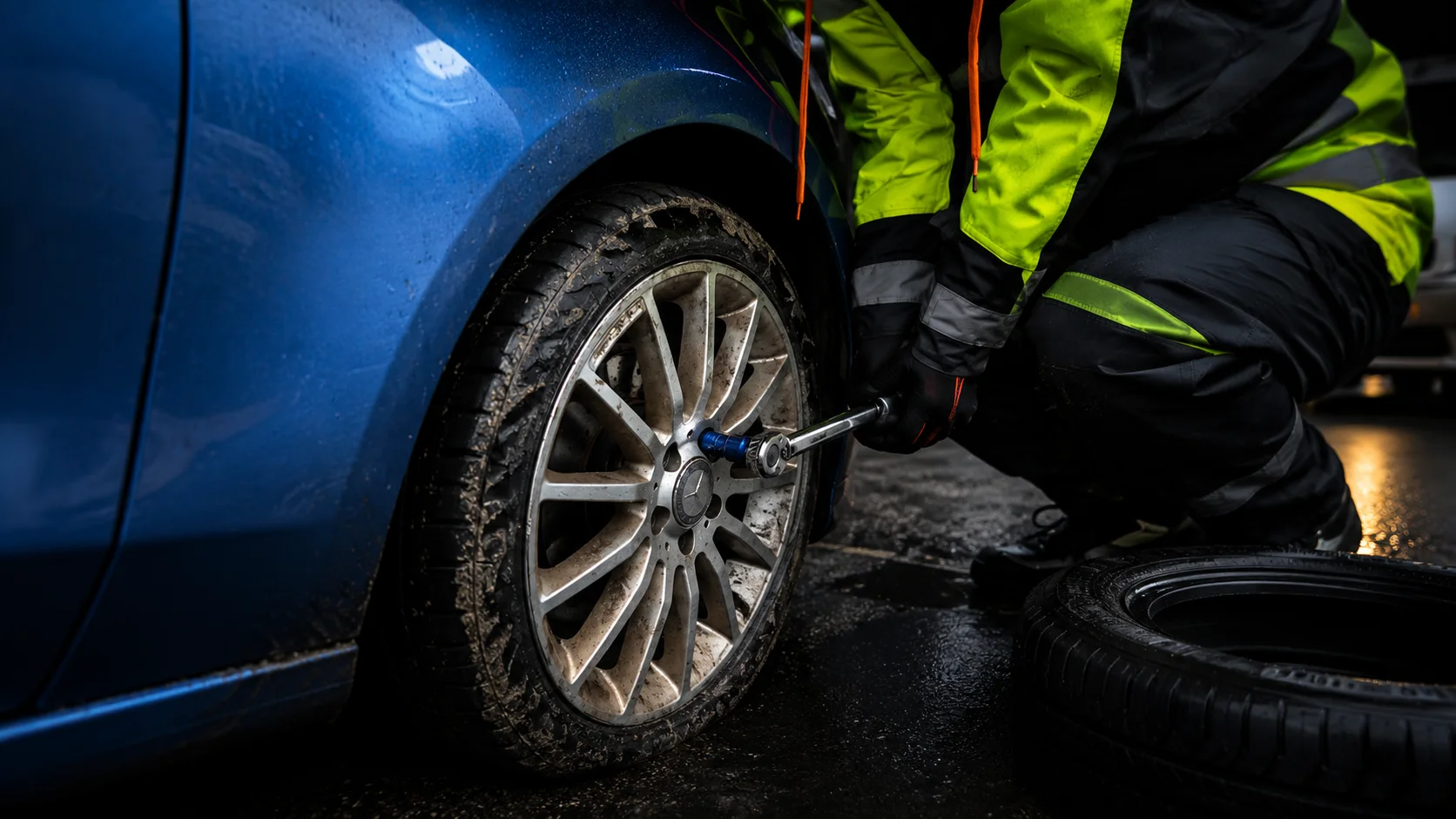
A modern SUV, maybe five years old, hits a pothole on a Glasgow road. The sidewall splits. The driver lifts the boot, finds the green can, and realises straight away it is the wrong tool for a sidewall split.
What they did right: they pulled over safely and called us before emptying the can into damage it was never going to seal. Smart move.
On arrival, our technician confirmed the sidewall was gone, fitted a matching new tyre, and had them moving again in around 25 minutes. No garage trip, no overnight wait. Home for the evening.
This pattern is stitched straight from our reviews. One customer hit a pothole and burst a tyre on Christmas Eve, and we had it sorted in 40 minutes. Another hit a pothole late at night and was back on the road inside the hour. Our technician Zack gets named more than once for turning up fast and keeping people calm.
Need us in your area? See our pages for Glasgow, Edinburgh, Aberdeen, Dundee, and Inverness.
Mobile tyre fitter vs breakdown recovery: honest comparison
There is no single right answer here. It depends on your situation, so here is the straight comparison.
| Option | Typical wait | What happens | Best when |
| Sealant kit (DIY) | 10 to 15 min if it works | Drive slowly to a fitter for a proper repair | Small tread puncture only |
| AA / RAC / Green Flag | 60 to 90 mins | Roadside attempt, often a tow to a garage | You are covered and not in a hurry |
| 24/7 Mobile Tyre Services | 30 to 45 mins | Diagnose and fit a new tyre on the spot | You are safe and need it sorted now |
| Traffic Scotland / 999 | Immediate | Lane closure and safety, not tyre fitting | Live lane or immediate danger |
We are not always the right first call, and we will say so. If the RAC covers you and you are parked safely on a driveway, wait for them. If you are in a supermarket car park at 9pm with kids in the back and just want a new tyre, that is exactly our job.
Scottish scenarios where having no spare gets ugly
The no-spare problem feels minor until geography makes it serious. These are the situations we get called to most.
On the A9 in the Highlands
Long single-carriageway stretches run for 30 miles or more with no garage. There are signal-dead zones from Pitlochry north to Inverness.
In those gaps, your sealant kit is your only option until you reach signal. If it fails on a sidewall split, you are waiting for someone to pass. This is the strongest case for carrying an aftermarket spare.
On the M74 corridor, pothole-burst country
Most of the flats we attend along here are pothole bursts, which means sidewall damage. The kit will not help.
We are based at Polmadie, right beside the M74, so this is the corridor where our response is quickest.
On the way to a ferry port
Ferries from Cairnryan, Stranraer, Ardrossan, or Oban do not wait. A flat with no spare can mean missing the sailing and rebooking.
A mobile fitter is usually the only realistic way to make the boat. If you are heading to Cairnryan, save our number before the M77 stretch.
In Glasgow city centre after the garages close
Most tyre garages shut by 5 or 6pm. After that, a sealant kit and an overnight garage is your only DIY route.
We run 24/7. If you are outside Buchanan Galleries at 9pm with a flat, that is the call we are built for.
Frequently asked questions
Is it illegal to drive without a spare tyre in the UK?
No. UK law does not require a spare wheel, and your car will not fail its MOT for not having one. You do have to keep all four fitted tyres legal, which means at least 1.6mm tread and no cuts or bulges.
Will my tyre sealant kit work on a sidewall puncture?
No. Sealant kits are made for small tread punctures, usually under 4mm. The sidewall flexes constantly under load, so any seal there would fail. A sidewall-damaged tyre has to be replaced.
How long can I drive after using sealant?
Most kits say under 50 mph for no more than around 100 miles, and only to reach a fitter. Always check your own kit’s instructions. It is a temporary fix to get you off the road, not a permanent repair.
Does using sealant ruin the tyre?
Not always, but it usually makes a proper repair harder and dearer. The sealant has to be cleaned out fully before a patch will hold, and some fitters charge for that. In practice, most sealant-treated tyres we see end up being replaced anyway.
Will sealant damage my TPMS sensors?
A factory-supplied kit generally will not. Some older aftermarket sealants can. Use the kit your car came with, and always tell the fitter you have used sealant so they can clean the sensor when the tyre comes off.
Do mobile tyre fitters come to you with a new tyre?
Yes, that is exactly what we do. Give us your tyre size from the sidewall plus your make and model, and we bring a matching tyre to your location. Typical arrival across Scotland is 30 to 45 minutes.
Should I buy an aftermarket spare wheel?
If you regularly drive remote Scotland, the A9, NC500, or Highland ferry routes, it is worth considering, because you become independent of mobile signal. For everyday urban driving, a saved fitter’s number is usually fast enough and costs nothing.
Do run-flat tyres mean I don’t need a spare?
Effectively yes, that is their purpose. After a puncture you can usually drive a run-flat around 50 miles at up to 50 mph to reach a fitter. But run-flats themselves are rarely repairable and normally need replacing after a puncture.
If you’re at the boot right now staring at the green can
You did the right thing by checking before guessing. Now keep it simple.
- Save our number: 07955 533000
- WhatsApp your location pin: wa.me/447955533000
- Tell us your tyre size and vehicle, and we bring a matching tyre
- Average arrival 30 to 45 minutes across mainland Scotland
- 24/7, all weather, Glasgow base with full Scotland coverage
If the damage is anything more than a small nail in the tread, the green can is not your answer. We are.
