
It has gone quiet. The other cars are home. You are sat in the driver’s seat, hazards blinking, looking at a flat tyre you can barely see in the dark.
The first thing to know is this. We are the call that exists for exactly this moment.
Drivers do not talk about night breakdowns the way they talk about daytime ones. The fear is bigger and the isolation is real. Here is exactly what to do, calmly, in order.
Short version: pull off the road, hazards on, stay in the vehicle with seatbelts on if you safely can, and call for help. We cover all of Scotland, 24/7, with a 30 to 45 minute average arrival. Do not try to change the tyre yourself in the dark.

Quick answer: what to do in the next 5 minutes
- Slow down gradually, do not brake hard.
- Pull off the road as far as you safely can. Aim for a well-lit spot if you have the choice.
- Hazards on, engine off, handbrake on, keys in your pocket.
- Interior light on briefly to find your phone, vest, and torch, then off again to keep your night vision.
- Stay in the car with doors locked, unless it is clearly safer to get out.
- Call for help, us on 07955 533000, your breakdown cover, or 999 if you are in immediate danger.
- Describe your location precisely, a postcode, What3Words, motorway marker, or nearest junction.
- Wait safely. Do not attempt the tyre yourself in the dark.
That is the whole plan. Everything below just explains the why.
Stuck right now? Call 07955 533000, 24/7, Scotland-wide. WhatsApp your location pin in two taps.
Stay in the car, or get out? The honest answer
This is the decision that keeps people safe, so let us be clear about it.
Stay in the car in most situations
- You are parked safely off the road, on a lit street or driveway
- You are on a quiet rural road but a safe distance from traffic
- You have passengers, especially children or older relatives
- It is cold, wet, or windy, because staying warm beats getting cold outside
- You do not know the area
Get out and stand behind the barrier only if
- You are on a motorway hard shoulder or Emergency Refuge Area. National Highways guidance is clear: exit through the left-hand doors and get behind the barrier.
- You are in a lane with traffic still moving past
- You smell fuel or smoke
- The vehicle is clearly at risk of being hit
Either way, what not to do
- Do not stand on the traffic side of the car
- Do not walk along a motorway hard shoulder unless you are heading to an SOS phone
- Do not try to flag down traffic
- Do not place warning triangles on a motorway, which is illegal because it means walking into live traffic
The official rules for stopping safely are set out in the Highway Code breakdown guidance if you want the full version.
Personal safety at night: the part most articles skip
We do not cover this because we have to. We cover it because every night-shift worker, every Highland driver, and every lone traveller already worries about it. So let us talk about it like adults.
If you are a lone driver
- Keep the doors locked from the inside. This is the single most important thing.
- Stay belted in, so you keep the option to drive away if you need to
- Keep your phone in hand, charging if you can, because battery is your lifeline
- Tell someone where you are, a quick text to a friend or family member with your location
If a stranger pulls over to help
Most people who stop are genuinely kind. You just cannot tell which is which in the moment.
- Crack the window an inch, do not lower it fully or unlock the door
- Thank them and say help is already on the way, whether it has arrived yet or not
- If you feel uneasy, call 999 and stay on the line until they leave
- Genuine helpers respect this and move on. Anyone who insists is the one to be wary of.
If you have children with you
- Keep them in their seats with belts on
- Use the interior light briefly so they can read or look at a phone
- Stay calm yourself, because they take their cue from you
- Give them a timeline: “The mechanic is coming, about 30 minutes”
If you are older or have mobility limitations
- Stay in the vehicle
- Use the eCall SOS button if your car has one
- Mention any medical needs to whoever you call
- The National Highways Hidden Disabilities Sunflower scheme can help mark your vehicle if you have a non-visible disability
Being seen in the dark
Visibility is half of night safety. Here is what actually works.
Use what is already on your car
- Hazard lights, always, and leave them on. Your battery will cope for hours.
- Sidelights on too, which adds outline visibility
- Interior light only when you need to find something, off the rest of the time
Use what you should carry
- A hi-vis vest, put on before you get out, not after
- A torch, ideally a head torch so your hands stay free
- A reflective warning triangle, for non-motorway use only
- A phone with full battery plus a charger, your single most important tool
What does not make you visible
- Standing in front of your headlights, because your shadow falls the wrong way
- Waving a phone torch at traffic, too small to register at speed
- Dark clothing with no reflective strip
Who to call, in what order
The right first call depends on your situation. Here is the simple version.
| Situation | First call | Then |
| Immediate danger (live lane, smoke, threat) | 999 | Breakdown cover or a mobile fitter |
| Motorway hard shoulder, no injuries | National Highways via SOS phone or 0300 123 5000 | A mobile fitter for the repair |
| Scottish trunk road (M8, M74, M77, M80, A9) | Traffic Scotland 0800 028 1414 (24/7) | A mobile fitter for the repair |
| Local road or driveway, safely stopped | Us on 07955 533000 | Nothing else needed |
| You have cover and no rush | Your provider | Wait may be 90+ mins at night |
How fast help actually arrives at night
Here are honest numbers, not sales numbers.
A mobile tyre fitter like us averages 30 to 45 minutes across Scotland, 24/7, in any weather. National providers like the AA, RAC, and Green Flag typically take 60 to 90 minutes by day, and often longer at night when patrol density is thinner.
Traffic Scotland can dispatch traffic management quickly, but they do not fit your tyre. The same is true of 999, which manages the scene rather than repairing the car. If you feel unsafe but are not in immediate danger, Police Scotland on 101 can carry out a welfare check.
Why mobile tyre fitting works in the dark
People assume darkness is a barrier. Once we arrive, it is not.
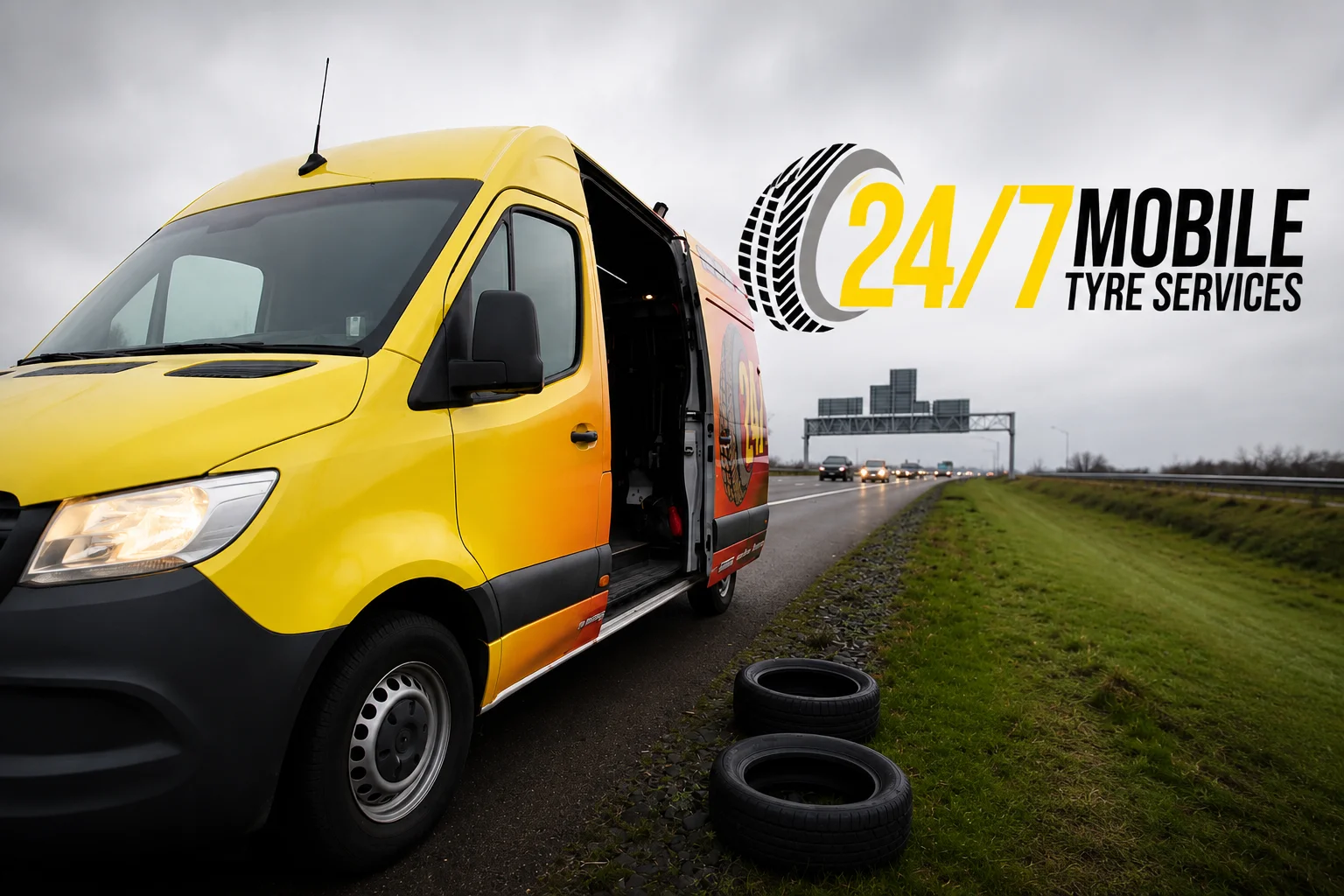
Our vans carry powerful work lights, so we can light up your wheel arch like daylight. On most night callouts we work in pairs, one on the tyre and one watching traffic. We carry spare hi-vis if you do not have your own.
The fit itself takes 15 to 25 minutes, the same as it does in daylight. If the damage is beyond a roadside fix, a destroyed sidewall or a broken alloy, we coordinate recovery rather than leaving you waiting.
Need us locally? See our pages for Glasgow, Edinburgh, Aberdeen, Dundee, and Inverness.
Cold and weather: the silent risk
In a stationary car in the cold, the temperature drops faster than people expect. Mild hypothermia, shivering and confusion, can begin within 30 to 60 minutes at near-freezing temperatures, and wet clothing speeds that up. Highland nights can sit 5 to 10 degrees colder than Glasgow.
Staying warm safely
- Run the engine in short bursts, around 10 to 15 minutes at a time
- Crack a window slightly while the engine runs, to prevent fume build-up
- Check the exhaust pipe is not blocked by snow or debris
- Keep a small blanket in the boot
- Move your arms and legs to keep circulation going
Run the engine or save fuel?
- Plenty of fuel and warm enough: engine off, save it for the drive
- Cold, low fuel, long wait: run it now and then
- Below freezing, remote, long wait: keep it running and prioritise warmth
Scotland night scenarios we know well
Night cuts across every cause of a flat. These are the situations we attend most after dark.
On the A9 in the Highlands
Pull completely into a layby, not just onto the verge. Signal is weak from Pitlochry north to Inverness, so prepare before you set off.
Deer collisions are a common cause of night flats up here, and they can damage suspension as well as tyres. Wildlife is most active at dawn and dusk, so stay extra alert then.
On the M74 corridor commute
Pothole bursts in the evening are our single most common pattern on this stretch. We are based in Polmadie, right beside the M74, so we are usually quickest here. On smart-motorway sections near Glasgow, aim for an ERA if there is no hard shoulder.
On the way to a ferry
Cairnryan sailings to Northern Ireland leave early, so many drivers are out from 3 or 4am. Ardrossan to Arran runs along the A78, and Oban sailings mean Highland driving in the dark. Ferry timing is unforgiving, and a flat can mean missing the boat.
Glasgow and Edinburgh post-shift drives
The drivers we hear from most at unsociable hours are hospital staff finishing late or early shifts, hospitality workers heading home after midnight, and cleaners and security staff on early starts. Tired, in the dark, on quiet streets. We are the call built for that.
A real night callout pattern we attend most weeks
We do not have to invent this one.
A worker is heading home from a late shift on a residential Glasgow street. They hit a pothole, the sidewall splits, and they are suddenly alone in a dark, quiet street.
What they did right: they pulled over, put the hazards on, called early, and did not try to inspect the wheel in the dark.
What we did: arrived in around 35 minutes with work lights and a matching tyre, fitted it in about 20 minutes, and had them home and indoors before midnight.
This pattern is straight from our reviews. We have late-evening callouts on record well past 10pm, and a Christmas Eve pothole burst we cleared in 40 minutes. The roadside safety we keep up while working gets mentioned by name in our reviews, which matters most when it is dark and you are on your own.
What to keep in your car for night breakdowns
A few minutes of prep now saves a miserable wait later.
Every car, every season:
- [ ] Hi-vis vest
- [ ] Torch, ideally a head torch, with fresh batteries
- [ ] Phone charger and a small power bank
- [ ] Saved numbers: us on 07955 533000, plus 999, 101, your insurer, and your breakdown cover
- [ ] Reflective warning triangle, for non-motorway use
- [ ] A basic first aid kit and a bottle of water
Scotland winter additions:
- [ ] A foil emergency blanket and a warm folded blanket
- [ ] Hat, gloves, and thick socks
- [ ] Energy snacks and a small ice scraper
- [ ] A printed copy of your insurance and recovery details, because paper works when signal fails
For Highland or remote trips:
- [ ] A power bank good for several charges
- [ ] Offline maps downloaded before you leave, plus the What3Words app
- [ ] Extra water and non-perishable food
- [ ] Location sharing switched on with a family member
Frequently asked questions
Is it safe to change a tyre at night?
Generally no. Visibility is reduced, traffic is harder to judge, and roadside changes are higher risk in the dark. National Highways says clearly not to change a tyre on a motorway hard shoulder. On a well-lit driveway with no traffic risk you can if you are confident, but most night flats are better handled by a mobile fitter who brings light, kit, and a second pair of eyes.
Should I stay in my car if I break down at night?
Yes, in most cases. Stay in the vehicle with the doors locked, seatbelts on, and hazards flashing. The exceptions are a live motorway lane, a smell of fuel or smoke, or an immediate threat. Then exit through the left-hand doors and get behind a barrier.
Do mobile tyre fitters work at night?
Yes. We operate 24/7 across all of Scotland, with a typical arrival of 30 to 45 minutes even at unsociable hours. Our vans carry work lights, so darkness is not a barrier to fitting on the spot.
Who do I call for a breakdown at night in Scotland?
For immediate danger, 999. For Scottish trunk roads like the M8, M74, and A9, Traffic Scotland on 0800 028 1414, which runs 24 hours. For the actual tyre fix, us on 07955 533000, typically 30 to 45 minutes anywhere in Scotland.
How long will a breakdown service take at night?
National providers such as the AA and RAC usually take 60 to 90 minutes by day, and longer at night when fewer patrols are out. A mobile tyre fitter is often faster, and we average 30 to 45 minutes across Scotland, day or night.
Is it safe to accept help from strangers at night?
Most people who stop are genuinely kind, but you cannot tell for sure. If a stranger pulls over, crack the window slightly rather than unlocking the door. Thank them and say help is on its way. Genuine helpers respect that and leave. If anyone insists, call 999 straight away.
Are mobile tyre fitters more expensive at night?
We charge fair, fixed rates around the clock, with no night surcharge on standard callouts. The cost depends on the tyre and the damage, not the hour. WhatsApp us for a transparent quote before you commit.
What if I’m in the Highlands with no mobile signal?
This is why we tell remote drivers to prepare ahead. Download offline maps, share your route, carry warm kit, and consider an aftermarket spare for genuinely remote travel. With no signal, walking toward the nearest village or main road may be necessary, but only in safe conditions.
If you’re stuck right now, here’s what to do
You have stopped, you are checking your options, you are handling this well.
- Hazards on, doors locked, stay belted in
- Call us: 07955 533000, 24/7, Scotland-wide
- WhatsApp your location pin: wa.me/447955533000
- Average arrival 30 to 45 minutes across Scotland, weather-independent
- No night surcharge, fair fixed rates
- We bring work lights, a matching tyre, and a calm voice
The dark makes everything feel worse than it is. Help is closer than it feels.
