Reviewed by the 24/7 Mobile Tyre Services technical team. BSAU 159 compliant puncture repairs across Scotland, every week.
You have spotted a nail or screw in your tyre. Your first instinct is to grab a pair of pliers and pull it out. Please don’t.
Here is the good news, and we say this after doing hundreds of these repairs on driveways across Glasgow and beyond. A nail or screw in the tread is one of the most fixable tyre problems you can have. If it sits in the central tread area and the hole is under 6mm, the UK BSAU 159 standard allows a proper permanent repair that lasts the remaining life of the tyre. Typical cost is £25 to £45.
So before you panic or assume you need a whole new tyre, read this. We will show you how to tell if yours is repairable, what to do in the next hour, and why pulling that nail out is the single worst first move you can make.
Quick answer: Most nail and screw punctures in the central tread are repairable for £25 to £45. Leave the object in place, mark its position, check your pressure, and call a fitter. Do not pull it out, because the nail is often plugging its own hole.

Why You Should Not Pull the Nail Out
This is the question we get most on the phone, and the answer surprises almost everyone. No, do not pull it out.
Here is what is actually happening. That nail or screw is wedged in tight, and more often than not it is partially sealing its own hole. The metal is acting like a plug. Pull it out and you remove the plug.
A slow leak you could have driven on becomes a flat in seconds. We have taken calls from drivers who tugged the nail out in the car park, watched the tyre deflate in front of them, and turned a £35 repair into a recovery job. There was no need for any of it.
What to do instead
- Leave it in place. The nail stays exactly where it is until a fitter looks at it.
- Mark the spot. A bit of chalk, tape, or even a tyre crayon makes it easy to find again.
- Check your pressure and note the reading, so you know if it is dropping.
- Photograph it from a couple of angles. A clear photo helps us tell you over WhatsApp whether it is likely repairable before we even set out.
- Call a fitter or drive cautiously, but only if the tyre is holding air.
The one exception
If the object is clearly just sitting on the surface and has not gone through the tread, and the tyre is holding pressure fine, then removing it at a fitter is no problem.
But here is the honest truth. You cannot reliably judge the depth from the outside. We cannot always tell from a photo either. The safe default is to leave it in until a professional has the wheel in hand.
What to Do in the Next Hour
If you have just found a nail or screw, here is your simple checklist.
- Do not pull the nail or screw out.
- Mark its position with chalk or tape, then photograph it.
- Check your tyre pressure and write down the reading.
- Read your tyre size off the sidewall, for example 205/55 R16 91V.
- Inspect the rest of the tyre. Look at the sidewall, the shoulder, and the valve for any other damage.
- Decide: drive slowly to a fitter, or have a mobile fitter come to you.
- Call us on 07955 533000. Scotland-wide, 24/7. Or WhatsApp the photo plus tyre size plus location and we will tell you if it is repairable before we head out.
That is genuinely it. Most callers go from worried to sorted inside the hour.
Is Your Puncture Repairable? The BSAU 159 Checklist
Tyre repairs in the UK are governed by a British Standard called BS AU 159. It is issued by the British Tyre Manufacturers’ Association (BTMA), and every reputable fitter follows it. It is not optional, and it is the same standard a garage works to.
A puncture is repairable only when all of these are true.
| Check | Repairable | Not repairable |
| Location | Central 75% of the tread, the “minor repair area” | Sidewall, shoulder, or near the shoulder |
| Hole size | Under 6mm | 6mm or larger |
| Tread depth | Above the 1.6mm legal minimum | At or below 1.6mm |
| Internal structure | Cords and ply intact | Cords broken or ply separated |
| Previous repairs | None overlapping the new damage | Old repair in the same spot |
| Driven flat? | No, still holding most of its pressure | Yes, sidewall heat damaged |
| Run-flat tyre? | Standard tyre, normal rules apply | Run-flat driven on flat, usually no |
| Tyre age | Under 6 years (check the date code) | 6 years or older, replacement often advised |
If your damage passes every line, you are very likely looking at a simple repair. If it fails even one, it usually means a new tyre, and we will tell you that straight rather than dress it up.
Where Is the Puncture? Location Decides Everything
This is the part most drivers do not know, and it is the single biggest thing that separates a cheap fix from a replacement.
Central tread, the repair zone
The central 75% of the tread width is the area BSAU 159 allows us to repair. On a 200mm wide tyre, that is roughly the middle 150mm.
This part of the tyre is reinforced with steel belts and stays fairly flat against the road. A proper plug and patch here is genuinely as durable as the original tyre. No compromise.
Shoulder, the borderline zone
The shoulder is where the tread curves into the sidewall. BSAU 159 treats it as part of the sidewall, so it is not repairable.
The tyre flexes constantly here, and any patch in this zone is likely to peel away in time. We will not gamble your safety on it, and no honest fitter should.
Sidewall, never
The side of the tyre is unreinforced and flexes with every rotation. Sidewall damage is never repairable under BSAU 159. No exceptions.
A nail in the sidewall carries a blowout risk, much like a bulge in a tyre. The only safe answer there is replacement.
The 3 Types of Puncture Repair, and Which One Is Actually Safe
Not every “repair” is a real repair. This trips a lot of people up, so here is the plain version.
1. Rope plug from the outside (not BSAU 159 compliant)
A rubber rope is pushed into the hole from outside, without removing the tyre. These are the kits you see on Amazon, at petrol stations, and in motoring shops.
They are quick, cheap, and easy. They are also not a permanent fix and not BSAU 159 compliant. If a garage offers to repair your puncture without taking the tyre off the wheel, walk away. That is the clearest sign you are getting a rope plug, not a real repair.
Treat it as an emergency-only measure to limp to a proper fitter, nothing more. Some insurers may also flag a rope plug if it is left in as a long term fix.
2. Internal patch only
A rubber patch is applied to the inside of the tyre after taking it off the rim. Better than a rope plug, but it does not seal the external hole on its own.
It is acceptable for very small punctures, but it is rarely used alone these days. It is not the current gold standard.
3. Combination plug and patch (the gold standard)
This is the proper job, and it is what we do on the driveway. The tyre comes off the wheel, the damaged area is cleaned and prepared with a mill cutter, then a combined plug and patch seals the hole from the inside with vulcanising cement.
It restores the original speed rating, load capacity, and MOT-pass quality. It lasts the remaining life of the tyre. This is the only repair worth paying for, and it is identical to what you would get in a workshop.
Driving With the Nail In: Can You? Should You?
It depends entirely on whether the tyre is holding air. Here is how we talk drivers through it on the phone.
If the tyre is holding pressure
A short trip, under 10 miles and under 50 mph, to reach a fitter is generally fine.
Keep an eye on the pressure if your car shows it, and pull over if it drops noticeably. Stay off motorways and fast A-roads where you can, and do not load the car up with passengers or heavy cargo for the run.
If the tyre is losing pressure
Do not drive far. The leak speeds up as the wheel works, and a manageable problem becomes a roadside one quickly.
Either fit your spare if you have one, or call a mobile fitter to you. A top-up at a petrol station buys a few more miles at best, and a sealant kit is a last resort with real limits.
If you cannot tell
Re-check the pressure in an hour or two. Any noticeable drop means call for help. No change means you can drive cautiously to a fitter, or simply have one come out.
The mobile fitter advantage
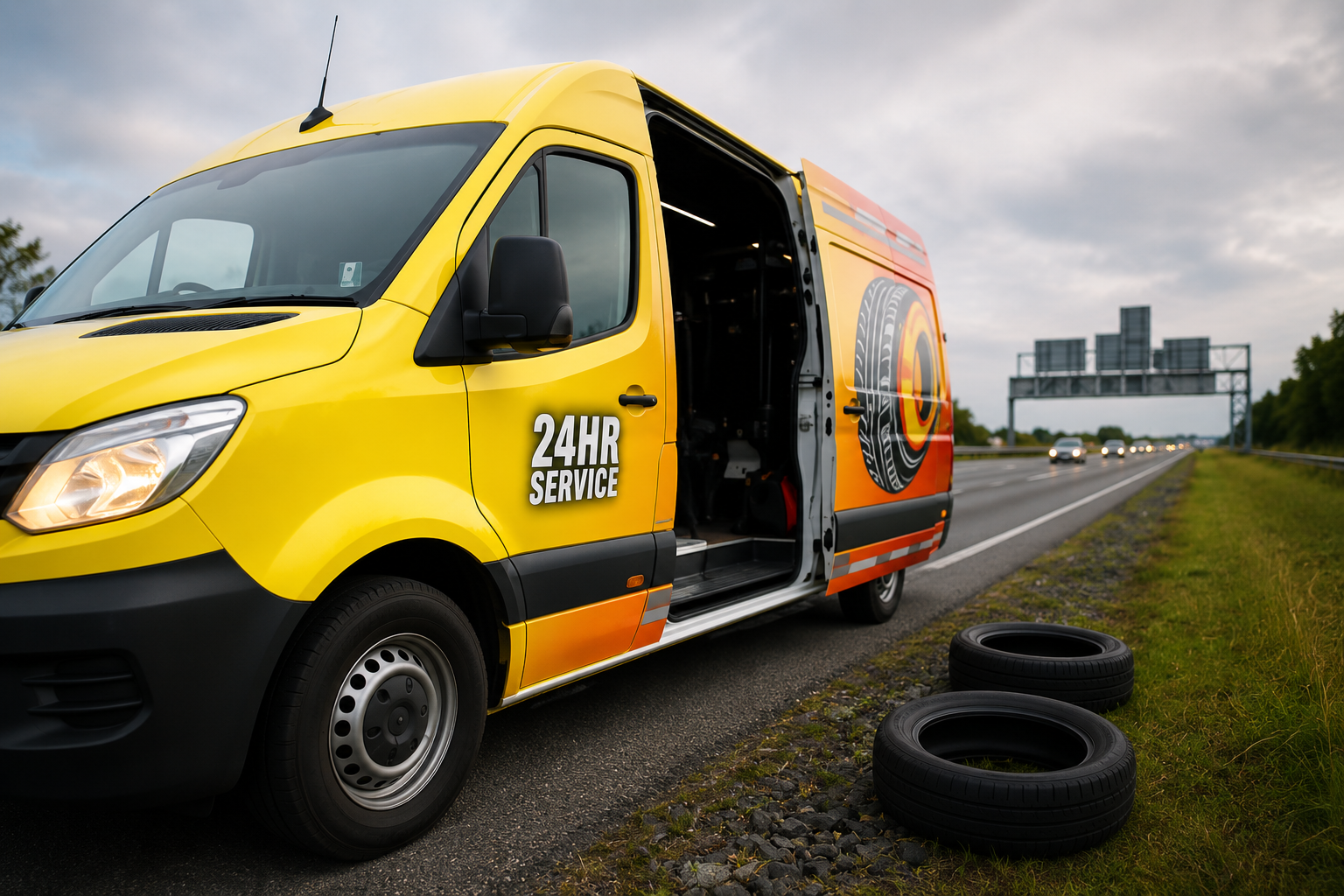
Honestly, the cleanest option is to skip the decision altogether. We come to you, so there is no risk of the leak worsening on the drive.
The same BSAU 159 repair gets done where you are, and most drivers are back on the road inside the hour. No garage queue, no waiting room.
Cost: Honest UK Pricing
We will always quote for your exact tyre size, but here is the realistic picture so you know roughly what to expect.
| Service | Typical UK cost | Notes |
| BSAU 159 plug and patch repair | £25 to £45 | The proper repair, lasts the life of the tyre |
| External rope plug (not recommended) | £10 to £20 | Temporary only, not compliant |
| Valve core replacement | £5 to £15 | If the leak is the valve, not a puncture |
| Valve stem replacement | £15 to £30 | If the full valve assembly is damaged |
| Single tyre replacement (budget) | £60 to £100 | If the puncture is not repairable |
| Single tyre replacement (mid-range) | £80 to £160 | Most UK family cars |
| Single tyre replacement (premium) | £140 to £300+ | Performance, run-flat, large diameter |
A quick word on mobile pricing. Our prices sit very close to garage prices, sometimes equal, sometimes a little more to reflect the convenience of us coming to you. Always ask for the price on your exact tyre size, and ask about any callout or diagnosis fee, before you agree to the work. Any fitter who will not give you that up front is one to be wary of.
Run-Flat Tyres: The Special Case
Run-flats need their own rules, so do not skip this if you drive a BMW, Mini, Mercedes, or a performance car.
What is a run-flat?
It is a tyre with a reinforced sidewall built to carry the car’s weight even at zero pressure. After a puncture, you can usually drive around 50 miles at up to 50 mph to reach a fitter.
You can spot one by the markings on the sidewall:
- RFT (Bridgestone)
- ROF (Goodyear)
- ZP (Michelin, Zero Pressure)
- SSR (Continental)
- MOE (Mercedes original equipment)
- DSST (Dunlop)
Why repair is restricted
The internal sidewall reinforcement can be damaged once the tyre runs flat, even after only a few miles. That damage often is not visible from the outside.
For that reason, most manufacturers advise replacement rather than repair after any flat-running event.
When repair might still be possible
There is a narrow window. If you catch the puncture early, before the tyre has actually run flat, and the pressure is still healthy, and the damage is in the central tread under 6mm, some manufacturers allow a repair.
Others do not, full stop. The honest move is a proper inspection first, because run-flats cost a fair bit more to replace, so it is always worth checking before you spend.
How Many Times Can One Tyre Be Repaired?
A fair question, and the answer depends on the tyre.
Standard tyres. There is no fixed legal limit, as long as the repairs do not overlap each other. In practice, two to three repairs per tyre is the sensible ceiling, since each one slightly reduces the overall integrity.
High-performance tyres (V rating and above). V-rated (149+ mph), W-rated (168+ mph), and Y-rated (186+ mph) tyres are different. Many manufacturers limit these to a single repair, and some prohibit any repair on Y-rated and ZR tyres. Always check the guidance for your specific tyre.
Run-flats. One repair maximum if any is allowed at all, and most makers do not recommend repairing them.
MOT, Insurance, and the Practical Stuff
These are the worries that come up after the relief wears off, so let us settle them.
Will a repaired tyre pass its MOT?
Yes, as long as the repair was done to BSAU 159 standard. A proper plug and patch is invisible from the outside and restores the tyre’s performance.
Tread depth, sidewall condition, and the rest still have to meet MOT requirements in their own right. A visible DIY rope plug, on the other hand, can cause a fail if it is leaking or sitting in the tread.
Insurance
A BSAU 159 compliant repair is treated as factory-standard durability, so it normally does not affect your cover. DIY rope plugs and sealant may be flagged if they contribute to an incident.
Standard car insurance rarely covers tyre damage itself. Separate tyre insurance, if you have it, usually covers either a repair or a replacement.
Lease and PCP returns
If you are handing a leased or PCP car back, a BSAU 159 compliant repair is acceptable under BVRLA fair wear and tear guidance. Keep the receipt as proof.
DIY rope plugs are a different story. They are often marked down as “not fit for purpose” at handback and charged to you.
A Scotland Note: Where We See Nails the Most
After enough callouts, you start to see the patterns in where drivers pick these up.
- Construction debris. Glasgow’s newer housing areas like Robroyston, Maryhill, and the Hamilton fringe throw up plenty of stray screws and staples.
- Trade routes and industrial estates. Staples, screws, and sheet metal fragments on the approach roads.
- Motorway shoulders. Lorry-cargo debris on the M8, M74, and M77.
- Highland and farm tracks. Fencing staples, pallet nails, and wire from agricultural work.
- The NC500 and touring routes. These collect farm-vehicle debris faster than city roads, and we often hear from drivers in the days after a Highland trip who only find the nail back home.
There is also a winter wrinkle worth knowing. A nail hole exposes the internal steel belts to road salt, and a delayed repair between November and March risks corrosion creeping in around the puncture. In Scottish winters, getting it sorted promptly matters even more.
Wherever you are, we cover it. We attend Glasgow, Edinburgh, Aberdeen, Dundee, and Inverness, with honest Highland arrival times of 60 to 90 minutes for places like Pitlochry, Aviemore, and Fort William. If you are home from a trip, call from your driveway rather than risk the drive.
A Callout We See Most Weeks
Here is a job that lands on our schedule again and again, because it is so common.
A driver in Glasgow’s Southside does a quick walk-around before the school run and spots a screw head sitting in the front-left tread. The tyre had been losing a couple of PSI a day for about a week, and they had put it down to the cold snap. The reason was right there.
On arrival, we confirmed it: a 4mm screw, lodged in the central tread, well inside the BSAU 159 repair zone, with the rest of the tyre in good shape and around 4mm of tread left. A textbook repairable puncture.
We took the wheel off, removed the tyre from the rim, cleaned the damage with a mill cutter, fitted a combined patch and plug with vulcanising cement, rebalanced the wheel, and refitted it. About 45 minutes on the driveway. The school run still happened on time, and the repair came to £35 instead of a £140 new tyre.
That is the whole point of catching these early and not panicking. Most of the time, this is a small fix, not a big bill.
Why Mobile Fitting Wins for a Nail in the Tyre
We are not knocking garages. We just think for this particular problem, coming to you makes more sense.
- It is the same BSAU 159 repair, the same equipment, the same durability you would get in a workshop.
- It happens where you are, on the driveway, at work, or wherever you noticed it.
- There is no risk of the puncture worsening on a drive to the garage.
- No one-to-two-hour wait in a reception.
- Honest scope. If the location is borderline, near the shoulder say, we tell you the truth and offer replacement. There is no upsell, because we make money either way and have no reason to push one over the other.
- If it genuinely is not repairable, we bring a matching tyre and fit it there and then. One visit.
- Arrival across urban Scotland is usually 30 to 45 minutes, any hour, any day.
That last point about honesty matters to us. As the reviews on our Google profile show, drivers remember being told the straight version. We diagnose, we do not guess, and we do not sell you a tyre you do not need.
Frequently Asked Questions
Should I pull a nail out of my tyre?
No. The nail or screw is often partially sealing its own hole, so pulling it out can cause rapid air loss and turn a slow leak into a flat in seconds. Leave it in place, mark its position, check your pressure, and either drive cautiously to a fitter or call a mobile fitter to you.
Can a tyre with a nail in it be repaired?
Usually yes, if the nail is in the central 75% of the tread, the hole is under 6mm, the sidewall and shoulder are undamaged, and the tyre has not been driven flat. UK BSAU 159 governs safe repair, and a proper plug and patch from inside is the gold standard. Typical cost is £25 to £45, and it lasts the life of the tyre.
Is it safe to drive with a nail in my tyre?
A short trip at low speed is usually fine if the tyre is still holding pressure. Long motorway journeys are not, because the nail can shift and the hole can open up. The safest option is to have a mobile fitter come to you so you do not drive on it at all.
How much does it cost to repair a nail in a tyre in the UK?
A BSAU 159 compliant plug and patch repair typically costs £25 to £45. External rope plugs are cheaper at £10 to £20 but are not a permanent fix and not compliant. If the tyre needs replacing instead, expect £80 to £220 or more depending on size and brand.
How long does a tyre puncture repair last?
A BSAU 159 compliant plug and patch is designed to last the remaining life of the tyre, with the original speed rating and load capacity restored. Rope plugs and DIY kits are temporary only and can fail within weeks.
Can a run-flat tyre be repaired after a nail?
Usually not, especially if it has been driven on after the puncture, because the reinforced sidewall can be heat damaged. Most manufacturers recommend replacement. If you catch the puncture before the pressure drops, a repair might be possible, so check the sidewall markings and your handbook.
Does a tyre repair affect the MOT?
No. A proper BSAU 159 repair is invisible from outside, does not affect tread depth, and restores the tyre’s performance, so it has no impact on an MOT pass. A visible DIY rope plug that leaks can cause a fail.
How many times can a tyre be repaired?
Standard tyres can take a few repairs if they do not overlap, practically two to three at most. V-rated and higher performance tyres are often limited to one repair by the manufacturer. Run-flats are usually one repair maximum, if any is allowed at all.
Will a DIY puncture repair kit work?
The kits sold at Amazon, petrol stations, and motoring shops are external rope plugs. They are temporary emergency fixes only, not BSAU 159 compliant, and should not be treated as a permanent repair. Some insurers may not cover a claim where a DIY repair was left in as the long term fix.
Spotted a Nail or Screw? Here Is Your Move
You do not need to stress, and you almost certainly do not need to act on instinct.
- Do not pull it out.
- Mark its location and photograph it.
- Note your tyre size from the sidewall.
- Call us on 07955 533000. Scotland-wide, 24/7.
- Or WhatsApp the photo plus tyre size plus location and we will tell you if it is repairable before we set off.
BSAU 159 plug and patch at your driveway from £25. A matching replacement brought to you only if it genuinely cannot be repaired. Arrival of 30 to 45 minutes across urban Scotland, with honest Highland times.
Same standard as a garage. None of the queue. And the straight answer, every time.
