
You’re on the motorway. Everything seems fine until you hit 60mph then the steering wheel starts shaking. Nothing dramatic, but it’s there. A persistent vibration you haven’t noticed before.
Most drivers blame the road. “It’s just Sheffield’s potholes.” And sometimes that’s true. But a lot of the time, the answer is simpler: the tyres need balancing.
Tyre balancing is one of those maintenance jobs people know they’re supposed to do but don’t quite understand. That gap in knowledge makes it easy to dismiss or easy to be told you need it and not know whether you actually do.
At 24/7 Mobile Tyres in Sheffield, we balance every tyre we fit as standard. Not as an upsell. Because it genuinely makes a difference to how the car rides, how long the tyres last, and what it does to your suspension over time. This guide explains exactly what it is, when you need it, and what happens if you don’t bother.
What Is Tyre Balancing?
Tyre balancing is the process of correcting uneven weight distribution in your tyre and wheel assembly by attaching small metal weights to the rim. This ensures the wheel spins smoothly without wobbling or vibrating as it rotates.
No tyre or wheel is perfectly uniform. The rubber in a tyre is never exactly the same density all the way around. Even a brand-new tyre fresh from the factory has tiny weight variations across its circumference. The wheel rim adds its own small imperfections. Combined, these differences create an imbalance one side of the assembly is fractionally heavier than the other.
At low speeds, that imbalance is barely noticeable. At 50, 60, 70mph, the wheel is spinning fast enough that even a few grams of difference creates a detectable wobble. That’s the vibration you feel.
The fix is straightforward: add small weights to the lighter side of the rim to counterbalance the heavy spot. The result is a wheel that spins evenly at any speed.

What Actually Happens During a Tyre Balance?
The process is quicker than most people expect.
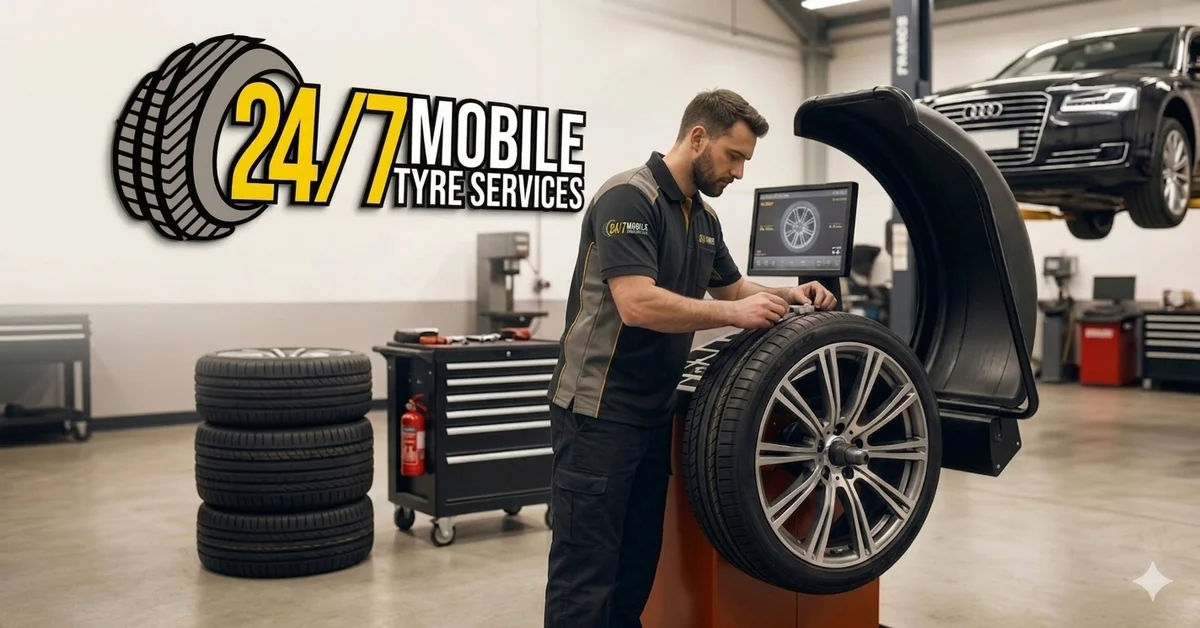
The wheel and tyre assembly is removed from the car and mounted onto a computerised balancing machine. The machine spins the wheel at high speed similar to road speed while sensors measure where the weight is uneven, both side-to-side and up-and-down.
The machine calculates exactly how much weight is needed and where it should sit on the rim. The technician attaches small metal weights either clip-on weights that grip the rim edge, or adhesive weights that stick to the inner face of the rim on alloy wheels.
The wheel is spun again to confirm the balance reads zero. Then it goes back on the car.
Start to finish: around 10–15 minutes per wheel. For a full set of four, you’re looking at 45–60 minutes.
Where Do the Balancing Weights Go?
On steel wheels, technicians use clip-on weights small metal pieces that clamp to the rim edge. They’re visible if you look closely at the inside of a steel wheel.
On alloy wheels, adhesive weights are often used on the inner rim face to keep them hidden and protect the alloy’s finish. If you’ve ever peeled a small metal strip off an alloy wheel rim without realising what it was — that was a balancing weight.
Removing those weights, however innocently, throws th balance off again. Worth knowing.
Tyre Balancing vs Wheel Alignment What’s the Difference?
This is the question we get asked constantly, so let’s settle it once and for all.
The one-line rule:
- Tyre balancing = smoothness. It corrects uneven weight in the wheel assembly.
- Wheel alignment = straightness. It adjusts the angles of the wheels relative to the road and to each other.
They’re completely separate services. A car can have perfectly balanced tyres and still pull to the left. A car can have perfect alignment and still vibrate at 65mph.
Alignment affects how your tyres meet the road the tilt, the toe angle, the direction. When it’s off, the car drifts to one side, the tyres wear on one edge, and handling suffers. Balancing doesn’t touch any of that.
When you get new tyres fitted, both should be checked. They’re not the same job, but they often make sense to do together.
The Three Types of Tyre Balancing Explained
Most drivers don’t know there’s more than one type. This is one area where competitors consistently give a shallow answer.
Static Balancing
The oldest method. The wheel is placed on a non-moving balancer to find a heavy spot. Weights are added to the opposite side.
It only corrects imbalance in a single plane. Fine for basic applications, but not sufficient for modern cars or higher-speed driving. Rarely used now.
Dynamic Balancing (The Standard Method)
This is what you’ll get at any reputable garage or mobile tyre service. The wheel spins on a powered machine that measures imbalance in two planes simultaneously side-to-side as well as vertical.
This is what corrects the vibration most drivers experience and what 24/7 Mobile Tyres uses as standard. It handles the vast majority of balancing issues.
Road Force Balancing (The Most Accurate Method)
This is the next step up when standard dynamic balancing doesn’t fully resolve the vibration.
A roller is pressed against the spinning tyre to simulate the pressure of the road surface. This reveals problems that a standard balancer can’t find such as a tyre with an inconsistent internal structure, or a high spot in the tread that makes the tyre slightly oval rather than perfectly round.
It’s also used to find the best rotational position of the tyre on the rim (called “match mounting”), which can reduce the amount of weight needed.
If you’ve had your tyres balanced and the steering wheel is still shaking road force balancing is the next thing to ask about.
How Do You Know Your Tyres Need Balancing?
The Signs to Look For
Vibration in the steering wheel at motorway speed is the most common symptom. It usually starts appearing between 50–70mph and may ease off slightly at higher speeds. If it only happens in that speed window that’s a classic tyre imbalance pattern.
Vibration in the seat or floorboard rather than the steering wheel suggests the rear tyres are the issue, not the fronts.
Uneven tyre wear patches wearing faster than others, or the tread looking cupped or scalloped when you run your hand across it.
A persistent low-frequency thump or hum that correlates with your road speed and changes as you accelerate or slow down.
Fuel economy dropping with no obvious explanation unbalanced tyres create extra rolling resistance.
The Speed Test A Practical Diagnostic
Not all vibrations are tyre balance problems. Speed helps narrow it down:
- Under 40mph: If it vibrates here, tyre balance is less likely the cause. Could be a wheel bearing, worn suspension, or brake issue.
- 50–70mph: This is the sweet spot for tyre imbalance. If the vibration appears and intensifies in this range balance is a strong candidate.
- Eases at 80mph+: Counterintuitively, imbalance vibrations sometimes reduce at very high speeds. This is a known behaviour of tyre imbalance.
Steering Wheel or Seat Which Tyre Is the Problem?
This is a useful bit of self-diagnosis before you call.
- Vibration in the steering wheel → almost always the front tyres
- Vibration in the seat or floor → almost always the rear tyres
- Vibration throughout the whole car → could be multiple wheels, or something other than balancing
What Causes Tyres to Go Out of Balance?
The Obvious Causes
Hitting a pothole or kerb is the most common trigger. Sheffield’s roads particularly after winter take a proper battering. A single hard pothole impact can knock a balance weight clean off the rim. The vibration often appears within days.
Kerb strikes even a light clip parking can dislodge weights.
Flat tyre repairremoving and remounting the tyre for repair can disturb the balance.
Fitting new tyres without balancing this happens. Not all fitters include balancing, or they rush the job. New tyres always need balancing before they go on.
The Less Obvious Causes
Normal tread wear over time. As the rubber wears, the weight distribution across the tyre changes gradually. This is why balancing every 5,000–6,000 miles is good practice even without any impacts.
The car sitting unused for weeks. Tyres can develop flat spots where they’ve been resting on the ground, creating a temporary imbalance. Usually resolves after a few miles of driving but if it doesn’t, get it checked.
Poor-quality or unevenly manufactured tyres. Budget tyres sometimes have inconsistent rubber density, which creates an inherent imbalance that weights can only partially correct.
What Happens If You Don’t Balance Your Tyres?
The Damage Chain Why It Gets Expensive
This is the part most guides gloss over. Let’s be direct about what actually happens over time.
Short-term (first few weeks/months): Vibration, discomfort, mild annoyance. The car is driveable.
Medium-term (months of driving on imbalanced tyres): Uneven tyre wear accelerates. You’ll be replacing tyres earlier than you should. A tyre that might last 30,000 miles under normal conditions may only manage 20,000.
Long-term (sustained neglect): The constant vibration puts stress on suspension components shock absorbers, springs, wheel bearings, ball joints, track rod ends. These wear prematurely. A set of wheel bearings can cost £150–£300 each to replace. Ball joints and track rod ends aren’t cheap either.
The cost of ignoring a £10-per-wheel balance job and instead replacing suspension parts is a stark contrast.
Can Unbalanced Tyres Cause a Blowout?
Yes, in extreme cases. Severe imbalance accelerates tyre wear unevenly. When one section of the tread wears significantly thinner than the rest, that section can fail under pressure particularly at motorway speeds.
It’s not a common outcome of mild imbalance, but it’s a real risk with tyres that have been running badly out of balance for an extended period.
Will Unbalanced Tyres Fail My MOT?
Not directly there’s no specific MOT check for wheel balance. But the consequences of unbalanced tyres can cause MOT failures: uneven tyre wear beyond legal tread depth limits, excessive play in suspension components, or wheel bearing problems. If an MOT tester spots severely cupped or uneven tread wear, the tyre may fail on safety grounds.
Unbalanced tyres are also a contributing factor to premature suspension wear which absolutely can fail an MOT.
Is It Safe to Drive on Unbalanced Tyres?
Short answer: You can, but you shouldn’t leave it more than a few weeks.
City driving at 30–40mph? The risk is lower. The vibration barely registers and the immediate danger is minimal.
Motorway driving at 70mph? A different story. The vibration is more severe, driver fatigue increases, handling is compromised, and the long-term damage to tyres and suspension accumulates faster.
If the vibration has appeared suddenly after a pothole especially if it’s noticeably worse than before get it checked before your next long motorway run.
If you regularly drive Sheffield to Leeds or Manchester on the M1 and M62, or you use the A57 Snake Pass into Derbyshire and the Peak District unbalanced tyres at sustained speeds is not something to leave for weeks.
How Often Should You Get Tyres Balanced in the UK?
The Standard Recommendation
- Every 5,000–6,000 miles as a general maintenance interval
- Every time new tyres are fitted — always, without exception
- After any pothole or kerb impact significant enough to feel through the car
- After a flat tyre repair — the tyre has been removed and remounted
- Any time you notice vibration — don’t wait for the scheduled interval
Sheffield-Specific Advice
Sheffield’s road network is hard on tyres. The city’s topography means steep roads, tight turns, and — particularly after cold winters potholes that can appear overnight on the A57, the ring roads, and routes through areas like Hillsborough, Heeley, and Crosspool.
If you regularly take the Snake Pass or Woodhead Pass into the Peak District, the road surfaces vary significantly. A weekend trip on rough moorland roads can knock a weight off just as effectively as a city pothole.
For Sheffield commuters doing high mileage on urban roads, checking balance every 5,000 miles is sensible practice. For occasional drivers doing mostly short local trips once a year or when symptoms appear.
How Much Does Tyre Balancing Cost in the UK? (2026)
| Service | Typical UK Cost |
| Standalone wheel balance (per wheel) | £7–£15 per wheel |
| Full set of four (standalone) | £28–£60 |
| Included with new tyre fitting | Often included free |
| Mobile tyre balancing (call-out to you) | Included with mobile fitting service |
At 24/7 Mobile Tyres Sheffield, balancing is included as standard with every tyre we fit. You’re not paying extra for it. It’s part of the service.
If you need a standalone balance for example, you’ve hit a pothole and want the wheels checked call us on 07777 911 224 for current pricing. No membership, no hidden charges.
Is it worth paying for standalone balancing? If you’re experiencing vibration, absolutely. The cost of a balance is a fraction of what you’d pay if the vibration leads to premature tyre replacement or suspension wear.
Why Is My Steering Wheel Still Shaking After Balancing?
This is a question nobody answers properly and it’s one we hear fairly regularly.
If you’ve had tyres balanced and the vibration hasn’t gone, the balance may not have been the root cause. Or the balance wasn’t done correctly. Here’s what else to check:
When Balancing Isn’t the Problem
Bent or buckled wheel. A wheel that’s even slightly bent won’t balance properly regardless of how many weights are added. The deformation itself causes vibration. Needs a wheel repair specialist or replacement.
Worn wheel bearing. Wheel bearing wear creates a low-pitched hum or vibration that’s easy to confuse with tyre imbalance. Unlike imbalance, bearing vibration tends to persist at all speeds and may change when you gently steer left or right at speed. Wheel bearings need replacing by a mechanic.
Worn suspension components. Ball joints, track rod ends, shock absorbers, and bushes all wear over time. When they develop play or looseness, vibration follows. These need proper inspection.
Warped brake discs. This specifically causes vibration or pulsing through the steering wheel when braking — not usually constant vibration when cruising. If the shaking intensifies when you apply the brakes, this is the more likely cause.
Out-of-round or defective tyre. A tyre that isn’t perfectly circular due to a manufacturing defect or internal damage — creates a rhythmic bounce that no amount of balancing will fix. Road force balancing can detect this. A replacement tyre is the solution.
Poorly done balancing. Uncalibrated machines, untrained technicians, or old weights not being removed before adding new ones — these all produce a “balanced” result on the machine that isn’t actually balanced on the road.
If the vibration persists after balancing, the next step is asking for a road force balance assessment and having the suspension checked.
Does Tyre Rotation Include Balancing?
No — tyre rotation and tyre balancing are two separate services.
Tyre rotation moves tyres between positions on the car swapping fronts to rears, for example to even out wear patterns. It doesn’t involve removing the tyres from the rims or checking weight distribution.
Balancing checks and corrects the weight distribution of each individual tyre and wheel assembly.
The two services are often recommended together, and a good mobile tyre service will offer both. But rotation alone does not include balancing. Always confirm with whoever’s doing the work.
Do New Tyres Need Balancing?
Yes, every time without exception.
New tyres have weight variations in the rubber that need correcting before they go on the car. Fitting a new tyre without balancing it is a shortcut that causes problems immediately.
Any competent tyre fitter balances every new tyre as a matter of course. If a fitter doesn’t include balancing with a new tyre, that’s a red flag.
At 24/7 Mobile Tyres, balancing is part of the fitting process. It’s not an optional extra.
FAQ Real Questions, Straight Answers
What is tyre balancing?
Tyre balancing corrects uneven weight in your tyre and wheel assembly by adding small metal weights to the rim. It prevents the wheel from wobbling as it spins, which stops vibration, reduces tyre wear, and protects your suspension.
What does tyre balancing do?
It ensures the tyre and wheel spin evenly at all speeds. Without it, heavier spots in the assembly cause the wheel to wobble as it rotates creating vibration in the steering wheel or seat, wearing the tyre unevenly, and stressing suspension components over time.
What is the difference between tyre balancing and wheel alignment?
Balancing corrects uneven weight distribution in the wheel. Alignment adjusts the angles of the wheels relative to the road and each other. Balancing fixes vibration. Alignment fixes pulling to one side or uneven edge wear. They’re separate services but often worth doing together.
How do I know if my tyres need balancing?
The main signs are: steering wheel vibration at 50–70mph, a persistent hum or thump that changes with speed, uneven tyre wear, or vibration in the seat. If the steering wheel shakes at motorway speed but the car feels fine at 30mph — tyre balance is the first thing to check.
What does an unbalanced tyre feel like?
A noticeable vibration through the steering wheel at speed, typically between 50 and 70mph. It often feels like a rapid trembling rather than a shake. It may ease slightly at very high speeds. Rear imbalance tends to be felt as vibration through the seat or floor rather than the wheel.
Why does my steering wheel shake at 60mph?
The most likely cause is an unbalanced front tyre. The 50–70mph range is where tyre imbalance vibration is most commonly felt. Other possibilities include a bent wheel, worn wheel bearing, or worn suspension component — but tyre balance is the first thing to check.
Is it safe to drive on unbalanced tyres?
For short-term city driving at lower speeds, the immediate risk is low. For motorway driving at 70mph, unbalanced tyres compromise handling and accelerate tyre and suspension wear. Don’t leave it for more than a few weeks, and avoid long motorway runs until it’s sorted.
What happens if you don’t balance your tyres?
Uneven tyre wear, reduced tyre life, vibration, increased fuel consumption, and over time premature wear of suspension components including wheel bearings and shock absorbers. The longer you leave it, the more expensive the downstream damage.
Can unbalanced tyres damage suspension?
Yes. The continuous vibration from unbalanced tyres puts repeated stress on shock absorbers, wheel bearings, ball joints, and track rod ends. These components wear faster as a result. Replacing suspension parts is significantly more expensive than a tyre balance.
Will unbalanced tyres fail my MOT?
Not directly MOT tests don’t check wheel balance specifically. However, uneven tyre wear caused by imbalance can lead to tread depth failures. And the resulting suspension wear can cause failures in steering and suspension checks. Prevention is far cheaper.
How much does tyre balancing cost UK?
Typically £7–£15 per wheel as a standalone service, or £28–£60 for a full set. Many garages and mobile services include it free with new tyre fitting. At 24/7 Mobile Tyres Sheffield, balancing is included with every tyre we fit. Call 07777 911 224 for standalone pricing.
How often should I get my tyres balanced UK?
Every 5,000–6,000 miles as routine maintenance, every time new tyres are fitted, and after any significant pothole or kerb impact. If you feel vibration at motorway speed get it checked regardless of mileage.
Do new tyres need balancing?
Always. New tyres have natural weight variations that need correcting before they go on the car. A fitter who doesn’t balance new tyres is cutting a corner. At 24/7 Mobile Tyres, balancing is standard with every fitting.
Does tyre rotation include balancing?
No. Tyre rotation moves tyres between positions on the car to even out wear. Balancing corrects the weight distribution of each tyre and wheel. They’re separate services. Good practice is to do both at the same time, but rotation alone doesn’t include balancing.
Why is my steering wheel still shaking after balancing?
If vibration persists after balancing, the cause may be a bent wheel, worn wheel bearing, worn suspension components, warped brake discs, or a defective tyre that’s slightly out of round. Road force balancing can detect issues a standard balancer misses. Ask your technician to check the wheel and suspension too.
Sorted Here’s What to Do Next
Tyre balancing is simple in principle: even out the weight, stop the wobble. But ignore the warning signs long enough and it stops being a £10-per-wheel fix and starts being a suspension repair.
If your steering wheel is shaking at motorway speed don’t write it off as Sheffield roads. It might well be that pothole you hit on the way into town last week.
At 24/7 Mobile Tyres, we balance every tyre we fit as part of the service. If you’ve just had tyres fitted elsewhere and something doesn’t feel right or if you’ve been ignoring a vibration hoping it’ll sort itself — we can come to you. Home, work, wherever suits.
No garage visit. No waiting room. Sheffield and South Yorkshire, 24 hours a day, seven days a week.
Call or WhatsApp: 07777 911 224
Typical arrival: 30–60 minutes. Warranty included on all work.
